Venerable Luangpu Pramote Pamojjo
13 June 2026
Translated by Shi Ne Ling
If we look deeply,
this being whom we call our child—
we do not really know where they came from.
Through the workings of kamma,
they have come to live with us.
Perhaps they are even karmic creditors or debtors from past lives,
brought together with us once again by the force of kamma.
Many children bring their parents a great deal of concern and trouble.
Yet people often worry far more than necessary.
In truth, there is no need to worry so much.
Great meditation masters have taught in this way.
For example, Venerable Luangpu Khao once said:
When the parent birds are no longer around,
the young birds struggle to survive and still manage to live.
When the mother cat or dog is gone,
their young can still carry on.
Why, then, should human children be any less capable?
Reflecting in this way,
he eventually entered the monastic life.
So there is no need to worry excessively
about our children and grandchildren.
Many parents raise their children
without ever realizing that their children have already grown up.
They spend a lifetime raising them,
working tirelessly without pause.
By the time the children are grown,
the grandchildren are brought along for them to raise as well.
Can we love them?
Certainly.
Can we treat them with loving-kindness?
Of course.
But we should reflect:
One day, we will inevitably have to leave.
When that day comes and we are no longer here,
will they still be able to live on?
Yes, they will.
They can continue to live their own lives.
There is no need to worry excessively.
We simply continue to raise and care for them,
and as long as it is our responsibility,
we fulfill that responsibility to the best of our ability.
Yet the mind must understand the truth of life:
everything is uncertain.
If we were to die unexpectedly,
others would still be able to carry on.
Never have we seen children or grandchildren unable to survive
simply because one of us is no longer here.
Reflect even further:
suppose our children and grandchildren
really could not make it without us—
what then?
Sooner or later, they would still have to face death.
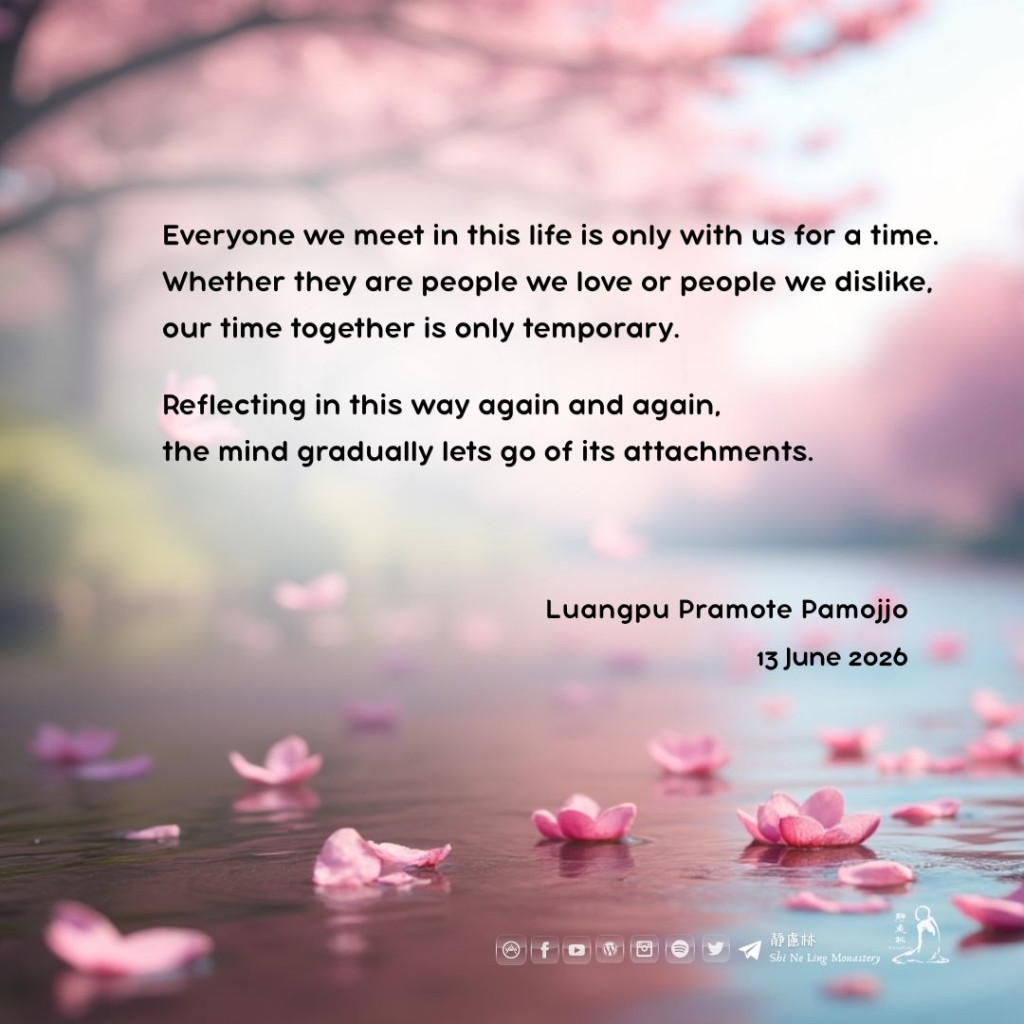
Everyone we meet in this life is only with us for a time.
Whether they are people we love or people we dislike,
our time together is only temporary.
Reflecting in this way again and again,
the mind gradually lets go of its attachments.
Can we love?
Yes, we can.
Can we care with loving-kindness?
Certainly.
But when the time comes to part,
we must be able to let go.
If we cannot let go—
whether of our children and grandchildren,
or even of a dog or a cat we keep—
then, at the moment of death,
if the mind is filled with worry and concern for them,
we may be reborn as a hungry ghost.
Having become a hungry ghost,
we might then follow closely behind that dog wherever it goes.
Therefore, we must learn to settle our own minds
and know when it is time to let go.
We do not know when death will arrive.
When we are no longer here,
whether those left behind are our loved ones
or the animals in our care,
each must live according to their own kamma.
They will be able to carry on by themselves.
Whether they fare well or poorly in life,
that depends on their own actions,
for their actions themselves are kamma.
What we can do is give them an education.
As parents,
we should provide our children
with the knowledge and skills needed to stand on their own,
and train them to live independently.
We should not hold them close forever,
caring for them day and night,
year after year,
for the rest of our lives.
Otherwise, when death comes,
we may still be burdened with worry and attachment,
and be reborn as a hungry ghost.
But if we have trained them well,
and know that they can live on by themselves,
the mind will no longer cling out of concern,
and we need not be reborn as a hungry ghost.
If we contemplate death often,
the mind gradually lets go of its attachments,
its grief and sorrow,
and its anger and resentment.
Message from Shi Ne Ling:
While we try our best, this translation may not fully convey the message of Luangpu’s teachings. Any mistakes or shortcomings are solely our responsibility.
Chinese Translation: